
01Self-help document preparation

Your denial,formally refuted.

Under two in a thousand people appeal a denied health claim. About half of the people who do appeal get the decision reversed. The gap is not courage. It is that nobody tells you which rules apply to you, or when your door closes.

Fixed promise
Every paragraph backed by a rule
Free to start
Four questions, no account
Rules current
5 Oct 2026 · version 2026.10.1
Every paragraph backed by a ruleDeadlines counted from your own letterArguments the insurer cannot knock backEncrypted. Never shared with your insurer.No outcome is ever promised
02

Almost nobody appeals. It works more often than not.

0.2%
of denied claims are ever appealed
Fewer than two people in a thousand push back.
50%
of filed appeals are overturned
Across internal review and independent external review.
180days
is a common internal-appeal window
Yours depends on your plan type. We work out which one you are on.
03

Three steps, and you are holding a filed appeal.

No part of this asks you to understand insurance law. It asks you to confirm what your own letter says.

01

Upload the letter

Photograph it with your phone or drop the PDF. We read the reason code, the claim number, the dates and the policy sections it cites.

02

Confirm what we read

Every fact sits beside the exact sentence it came from. You confirm, edit or reject each one. Nothing moves on until the required facts are confirmed.

03

See the route and the argument

Your appeal track, your deadlines with the rule behind each, the arguments that hold against their stated reason, and the letter that uses only those.

04

Their sentence on the left.
Your answer on the right.

Your plan document, § 11.2
You have the right to request an internal appeal within the timeframe specified in your plan documents.
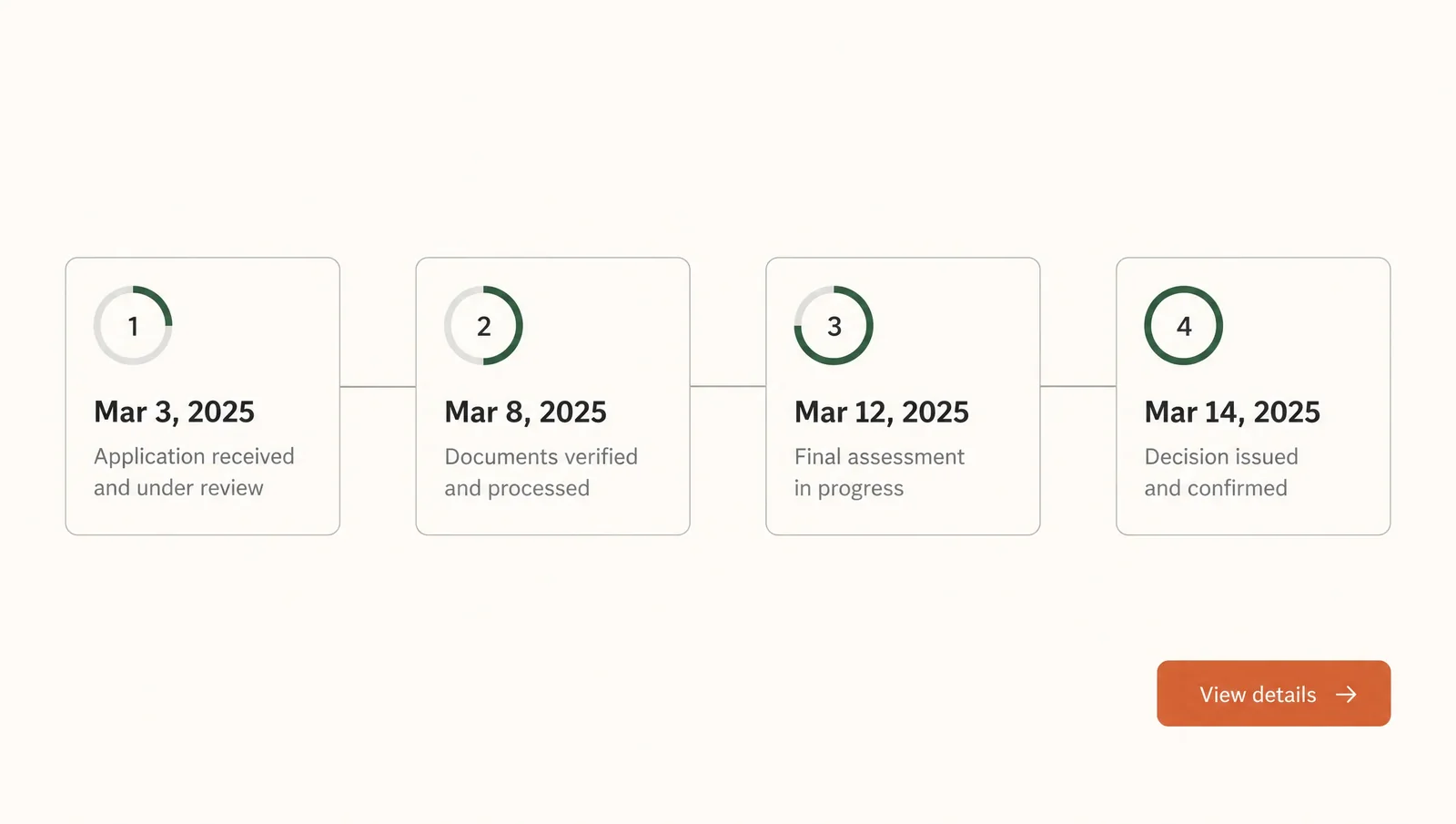
The procedural roadmap with deadlines

Your deadlines, and the rule each one came from

We read your plan type from the letter, then work out every date: when the internal appeal is due, how long they have to answer, and when the external review window opens and closes. Open any date to see the trigger date it was counted from and the regulation that sets the count.

29 C.F.R. § 2560.503-1(h)(3)(i) · counted from 14 Sep 2026
Your denial letter, page 1
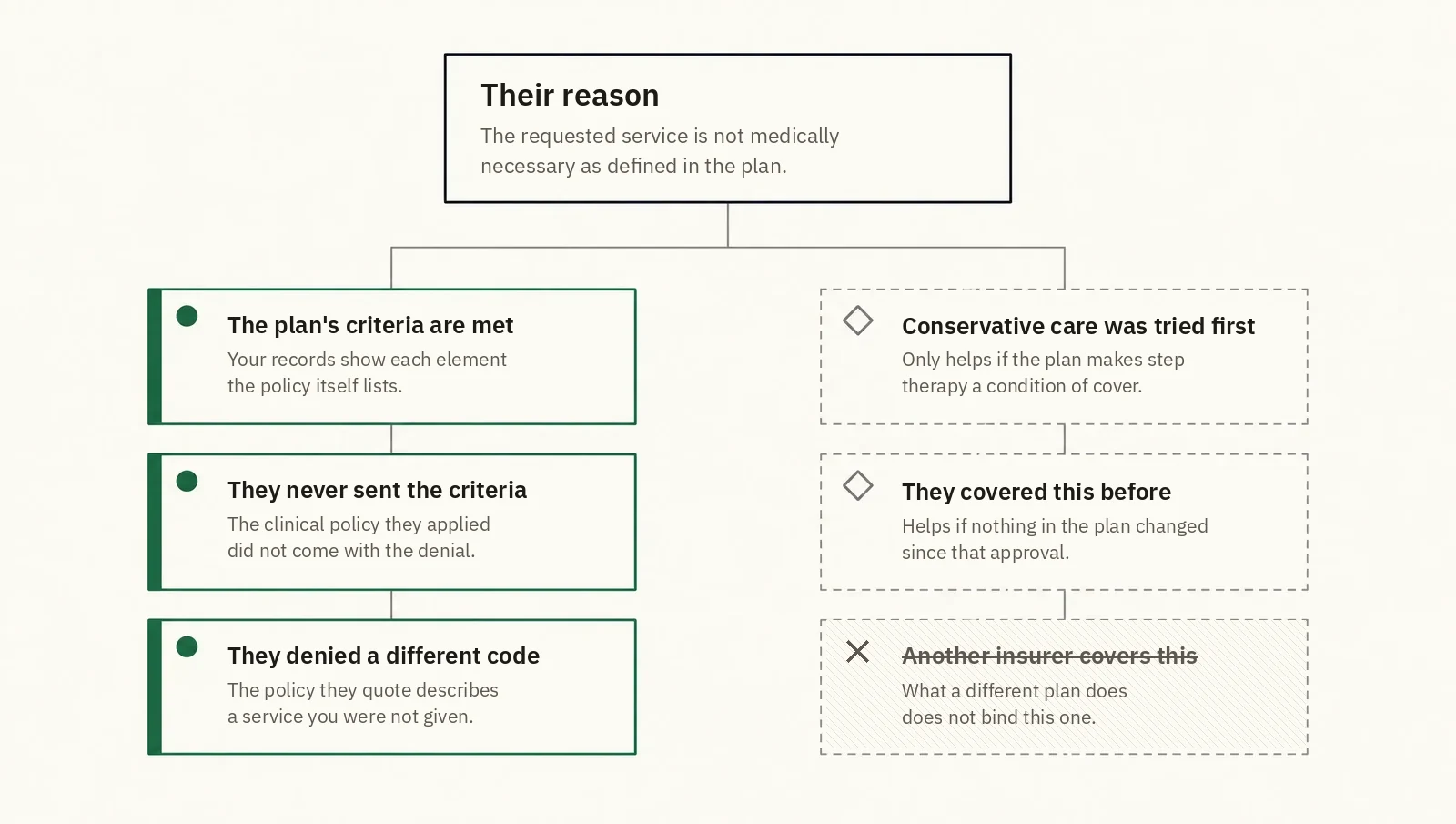
The requested service is not medically necessary as defined in the plan.
The argument graph, solid ground against worth adding

Solid ground, and worth adding

We treat that sentence as an argument and build the counter-arguments that attack it. Then we check each one against what the insurer would most likely say back. Three survive whatever they answer. Two only help under a narrow reading, so they are labelled that way instead of being passed off as strong.

Reason code CO-50 · 3 solid ground · 2 worth adding · 1 left out
Your denial letter, page 2
Plan provision 7.4(b) excludes services that are investigational.
A generated appeal letter page with citation markers

Every paragraph backed by a rule

The letter is assembled only from arguments that hold. Each paragraph carries the node it came from, so you can click a sentence and see exactly why it is in there. You edit it, you sign it, you send it. We tell you where to send it and how to prove it arrived on time.

Exports to PDF and DOCX · prints on US Letter with correct margins
Your denial letter, page 3
You may submit any additional documentation you wish the reviewer to consider.
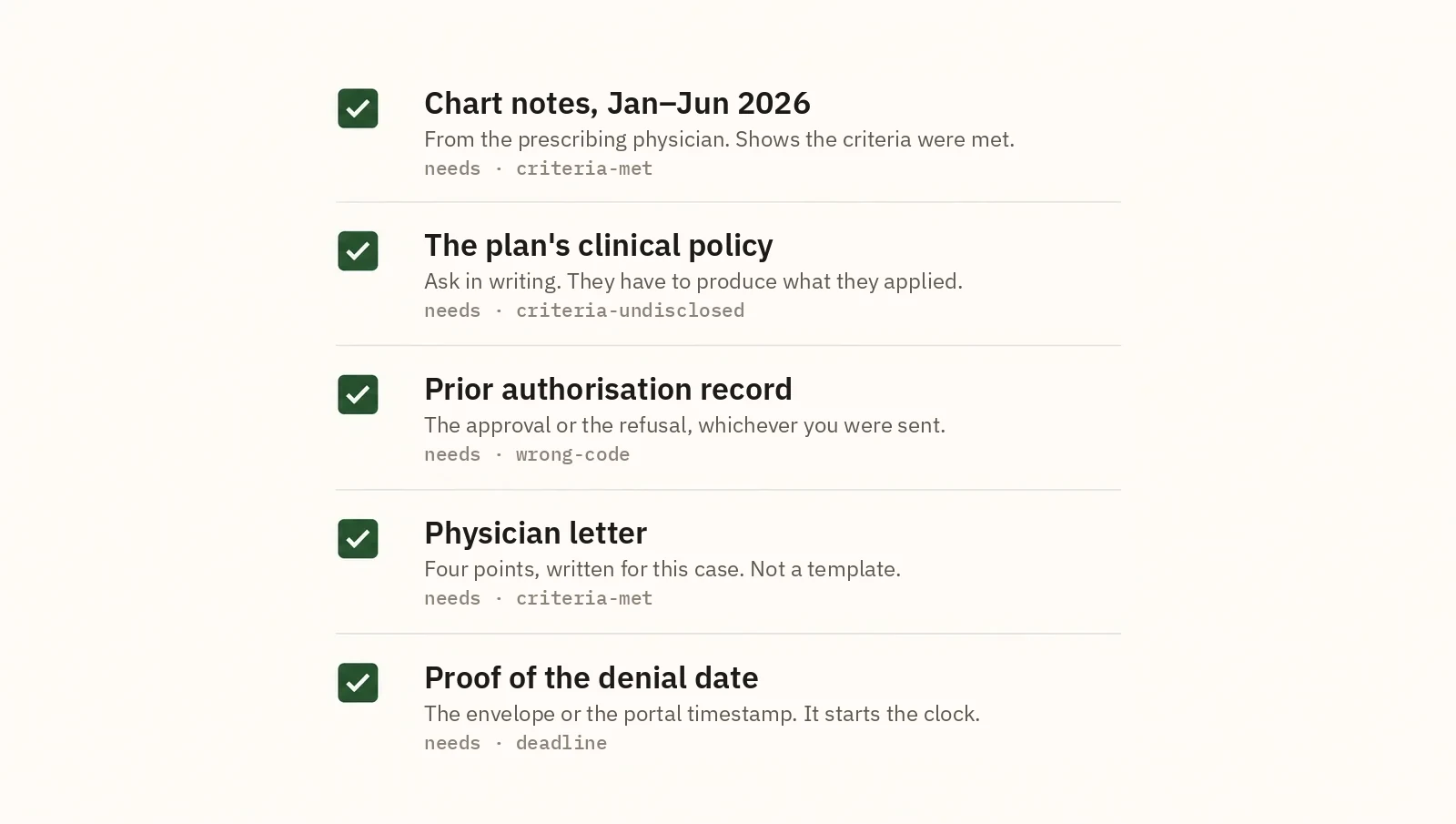
The evidence checklist, each item satisfied

The evidence list writes itself

That sentence is where most appeals quietly fail. We turn it into a specific list: which records, from whom, covering which dates, and the exact points your doctor’s letter has to make for this case. Each item says which argument needs it, so nothing on the list is there for padding.

8 items · 6 on file · 1 requested · 1 optional
05

Three people arrive here, in three different states of mind.

A person at a kitchen table with a letter, mid-afternoon
First time

You just got the letter

Three days ago. You have read it four times. You do not know whether this is normal or how long you have. Start with the free check.

A person managing a chronic condition at a laptop, prior correspondence beside them
Been here before

This is the fourth one this year

You know the process. You want the workspace, the dates, and the letter, without being explained things you already know.

A caregiver on a phone in a waiting room, handling it for someone else
For someone else

You are handling it for someone else

For a parent or a child, on a phone, between other things. The case holds its state and the reminders find you.

06

You find out whether you have a case before you pay.

The free check is the whole triage, not a teaser. If there is no route, it says so and you owe nothing.

Free check
$0

Four questions. Find out which track you are on and roughly when your door closes.

  • 01Likely appeal track
  • 02Estimated deadline with the rule
  • 03An honest read on whether to appeal
  • 04No account needed
Start the free check
Appeal PackageMost people choose this
$149once, per case

Everything needed to prepare and file one appeal, through external review if it gets there.

  • 01Document extraction you confirm line by line
  • 02Roadmap with every deadline cited
  • 03Argument graph: solid ground and worth adding
  • 04Evidence checklist and physician-letter template
  • 05Letter editor, PDF and DOCX export
  • 06Reminders at 30, 14, 7, 3 and 1 days
Open a case
Ongoing
$19per month

For people denied more than once a year, and for caregivers running several at a time.

  • 01Unlimited cases
  • 02Plan documents saved and reused
  • 03Family members and dependants
  • 04Reminder emails for every open deadline
Choose ongoing

Advocate Pro, with multi-case dashboards, comes later. No price yet.

07

The things worth knowing before you start.

Find out what your deadline is.

Four questions. No account, no card. If there is no route left, it will tell you that instead of selling you something.

Start the free check